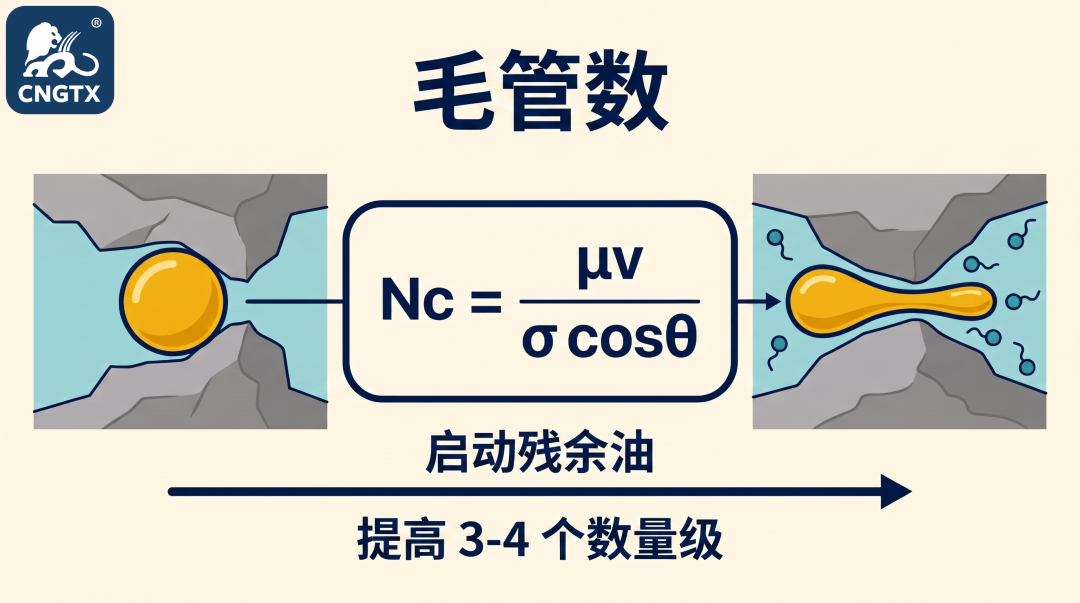
Part 2: Ultra-Low IFT and Five Displacement Mechanisms欢迎回到本系列的第二部分。在第一部分中,我们为您铺陈了微乳液驱 (Microemulsion Flooding)深厚的历史演革与热力学基础。现在,在第二部分中,我们将直面当前水驱技术所遭遇的严峻流体力学挑战,并全面揭示微乳液是如何凭借其独特的物理化学性质克服这些障碍的。本部分将以前所未有的细节,重点解析多因素协同作用是如何在微观孔隙尺度和宏观油藏尺度上,引发一场原油采收率革命的。Welcome back to Part II of our four-part series. In Part I, we laid out the profound historical evolution and thermodynamic foundations of Microemulsion Flooding. Now, in Part II, we will directly confront the severe fluid dynamic challenges encountered by current waterflooding technologies and comprehensively reveal how microemulsions overcome these hurdles relying on their unique physicochemical properties. This section will focus, with unprecedented detail, on decoding how synergistic multifactorial effects trigger a crude oil recovery revolution on both the microscopic pore scale and the macroscopic reservoir scale.在油田开发的二次采油(水驱)中后期阶段,流体在多孔介质中的流动规律由巨大的毛细管力所主导。这些毛细管力像无形的枷锁一样,将剩余油牢牢束缚在岩石微小孔隙的死角和盲端中。在常规水驱条件下,油水界面张力通常维持在 20~30 mN/m 的高位,导致微观驱替效率极低。为了在数学与流体力学上量化并解决这一困境,科学家们引入了毛管数 (Capillary Number, Nc)这一至关重要的无量纲参数。其计算公式被定义为 Nc = μv / (σ·cosθ)(其中 μ 为驱替液黏度,v 为渗流速度,σ 为界面张力,θ 为接触角)。学术界的共识是,若要显著启动残余油并提高驱油效率,必须将储层中的毛管数提高至少 3 到 4 个数量级。微乳液驱的提高原油采收率 (EOR)机理正是为了满足这一苛刻的物理要求而诞生的。它绝非单一的物理推进,而是一个涉及多因素深度协同作用的复杂过程,主要表现在以下五个不可或缺的核心方面:During the middle and late stages of secondary recovery (waterflooding) in oilfield development, the flow laws of fluids in porous media are dominated by massive capillary forces. These capillary forces act like invisible shackles, tightly binding the remaining oil in the dead corners and blind ends of the rock's minute pores. Under conventional waterflooding conditions, the oil-water interfacial tension typically remains at a high level of 20 to 30 mN/m, resulting in extremely low microscopic displacement efficiency. To quantify and resolve this dilemma mathematically and fluid-dynamically, scientists introduced a crucial dimensionless parameter known as the Capillary Number (Nc). Its calculation formula is defined as Nc = μv / (σ·cosθ) (where μ is the viscosity of the displacing fluid, v is the seepage velocity, σ is the interfacial tension, and θ is the contact angle). The academic consensus is that to significantly mobilize residual oil and enhance displacement efficiency, the capillary number in the reservoir must be increased by at least 3 to 4 orders of magnitude. The Enhanced Oil Recovery (EOR) mechanism of microemulsion flooding was born precisely to meet this rigorous physical requirement. It is by no means a single physical push, but rather a complex process involving the deep synergistic effect of multiple factors, which is mainly manifested in the following five indispensable core aspects:(1) 通过超低界面张力降低毛细管阻力。 当 Winsor III 型中相微乳液注入油藏时,其表面活性物质能够自发、高密度地吸附在原油与水相的交界处,将宏观的油水界面张力从常规的几十 mN/m 瞬间降低至 10⁻³ mN/m 甚至 10⁻⁴ mN/m 的极限超低水平。这种数量级上的骤降从根本上瓦解了毛管束缚力,使得原本被困在孔喉中、形态僵硬的残余油滴能够发生极度的拉长和变形,从而顺利通过极其狭窄的微小孔喉。值得向广大读者和研究者特别强调的是,在严谨的物理化学测量中,超低界面张力的测量需借助旋转滴界面张力仪 (Spinning Drop Tensiometer) 来实现。由于传统的吊滴法或白金环法在测量低于 1 mN/m 的张力值时存在理论局限和极大的误差,美国得克萨斯大学 (University of Texas) 在 20 世纪 70 年代率先研发了 Model 500 旋转滴界面张力仪,专为解决 EOR 领域的测量难题而生。其工作原理如下:在高速摄像机的精准监控下,密度较小的油滴被放置在充满密度较大的流体的透明毛细管中旋转。在强大的离心力作用下,油滴被沿旋转轴拉长为圆柱形,而试图使其恢复球形的唯一力量就是界面张力。研究人员通过测量液滴的几何变形量,并带入经典的 Vonnegut 方程或更加复杂的 Cayias-Schechter-Wade 模型,能够极其精确地计算出低至 10⁻⁶ mN/m 的超低界面张力。这一精密仪器的广泛应用,是验证微乳液配方能否成功触发极限驱油机制的关键标准。(1) Reducing capillary resistance through ultra-low interfacial tension. When a Winsor Type III middle-phase microemulsion is injected into the reservoir, its surfactant substances can spontaneously and densely adsorb at the boundary between the crude oil and the water phase, instantly reducing the macroscopic oil-water interfacial tension from conventional tens of mN/m down to an extreme ultra-low level of 10⁻³ mN/m or even 10⁻⁴ mN/m. This order-of-magnitude drop fundamentally disintegrates the capillary binding force, allowing the otherwise rigid residual oil droplets trapped in pore throats to undergo extreme elongation and deformation, thereby passing smoothly through extremely narrow pore throats. It is worth specially emphasizing to readers and researchers that in rigorous physicochemical measurements, measuring ultra-low interfacial tension requires a spinning drop tensiometer. Because traditional pendant drop or du Noüy ring methods suffer from theoretical limitations and massive errors when measuring tension values below 1 mN/m, the University of Texas in the United States pioneered the development of the Model 500 spinning drop tensiometer in the 1970s, born specifically to solve measurement conundrums in the EOR field. Its operating principle is as follows: under the precise monitoring of a high-speed camera, a less dense oil drop is placed in a transparent capillary filled with a denser fluid and rotated. Under the action of powerful centrifugal force, the oil drop is elongated into a cylindrical shape along the rotational axis, and the only force attempting to restore it to a spherical shape is the interfacial tension. By measuring the geometric deformation of the droplet and plugging it into the classical Vonnegut equation or the more complex Cayias-Schechter-Wade model, researchers can extremely precisely calculate ultra-low interfacial tensions down to 10⁻⁶ mN/m. The widespread application of this precision instrument is the key standard for verifying whether a microemulsion formulation can successfully trigger the ultimate oil displacement mechanism.下表总结了在微乳液驱油研究中,界面张力数量级对储层中流体流动状态的影响:The following table summarizes the impact of the order of magnitude of interfacial tension on fluid flow states in reservoirs during microemulsion flooding research:
界面张力数量级
适用测量方法
孔隙流体状态
采收率提升潜力
>10 mN/m
吊滴法 / 铂金环法
强毛管束缚,残余油孤立死锁
极低
1~10 mN/m
吊滴法
局部变形,难以通过细小喉道
较低
10⁻¹~10⁻² mN/m
旋转滴法
毛管阻力显著降低,油滴拉长
明显
<10⁻³ mN/m
旋转滴法
超低阻力,微乳液携油呈“油墙”推进
极高
(2) 改善油水流度比。 微乳液驱的卓越之处不仅在于微观级别的洗油效率,更在于其宏观尺度的波及控制。当微乳液注入油藏深部后,其体系的表观黏度往往显著高于普通的注入水,这有效地缩小了高流度驱替相(水)与低流度被驱替相(原油)之间的巨大差异。详尽的流体力学流场分析表明,这种流度比的科学改善能够极大地抑制由于流体前缘不稳定性引发的“黏性指进 (Viscous Fingering)”现象。它有力地防止了注入流体沿着高渗透通道的过早突破和水窜,从而显著扩大了化学液在储层水平面和纵向剖面上的宏观波及体积。(2) Improving the oil-water mobility ratio. The excellence of microemulsion flooding lies not only in its microscopic oil-washing efficiency but also in its macroscopic sweep control. After the microemulsion is injected deep into the reservoir, the apparent viscosity of the system is often significantly higher than that of ordinary injected water, which effectively narrows the massive disparity between the high-mobility displacing phase (water) and the low-mobility displaced phase (crude oil). Exhaustive fluid dynamic flow field analyses indicate that this scientific improvement in the mobility ratio can dramatically suppress the "viscous fingering" phenomenon triggered by fluid front instabilities. It forcefully prevents the premature breakthrough and water channeling of injected fluids along high-permeability channels, thereby significantly expanding the macroscopic sweep volume of the chemical fluid across both the horizontal areal and vertical cross-sectional planes of the reservoir.(3) 改变岩石润湿性。 在全球众多复杂油藏中,储层岩石表面的初始润湿性大多偏向亲油或中性润湿,这使得厚重的油膜紧紧贴附在岩石孔隙壁面上,极难被水流冲刷剥离。微乳液 (Microemulsion)体系中富含的高效表面活性剂分子,能够在热力学驱动下选择性地吸附在亲油的岩石矿物表面。它们将“亲油基团”牢牢锚定在亲油的岩石表面,而“亲水基团”指向水溶液严密排列,从而在固液界面上引发了岩石润湿性 (Rock Wettability)的根本性反转——将原本嗜油的表面强行反转为强水湿状态。这种关键的界面反转大幅度降低了原油分子在固体岩石表面的黏附功,促使顽固的油膜从岩石壁面上彻底剥离、卷缩成液滴。这一机制在裂缝性油藏或致密储层的自发渗吸采油过程中,发挥着核心作用。(3) Altering rock wettability. In many complex reservoirs worldwide, the initial wettability of the reservoir rock surfaces tends to be oil-wet or mixed-wet, causing thick oil films to adhere tightly to the pore walls, making it extremely difficult to be washed away by water flow. The highly efficient surfactant molecules abundant in the Microemulsion system can, driven by thermodynamics, selectively adsorb onto the lipophilic rock mineral surfaces. They firmly anchor the lipophilic groups onto the lipophilic rock surface, while the hydrophilic groups are closely aligned toward the aqueous solution, thereby triggering a fundamental reversal of rock wettability at the solid-liquid interface—forcibly flipping the originally oleophilic surface to a strongly water-wet state. This crucial interfacial reversal drastically reduces the adhesion work of crude oil molecules on the solid rock surface, prompting stubborn oil films to completely detach and roll up into droplets from the rock walls. This mechanism plays a core role during spontaneous imbibition oil recovery processes in fractured reservoirs or tight formations.(4) 增溶与乳化的协同效应。 中相微乳液体系特有的双连续网络结构,赋予了其对原油和水优异的增溶能力。在多孔介质中流经狭窄的孔喉时,微乳液能够源源不断地大量溶解被剥离的残余油和地层原水。它通过严格的物理化学相变,将原油大量增溶进入微乳液的内部相中,在驱替前缘形成一道连续不断、向前运移的富集“油墙”。与常规的机械力搅拌引发的动力学乳化有着本质的不同,这种基于热力学平衡的增溶 (Solubilization)作用很强,甚至能够溶解那些严重堵塞储层微小孔道的重质胶质和沥青质大分子。此外,当具有高黏弹性的微乳液流经不断收缩扩张的孔喉结构时,其强烈的乳化 (Emulsification)和黏弹性流变效应会导致液滴发生剧烈的弹性收缩和拉长变形。一旦微乳液越过孔喉进入相对开阔的孔隙,其瞬间发生的弹性恢复会对周围富集的原油产生巨大的黏弹性拖拽力,将其猛烈拉长并最终截断采出。这种力学与化学的协同作用,使孔隙级别的洗油效率显著提高。(4) Synergistic effects of solubilization and emulsification. The unique bicontinuous network structure of the middle-phase microemulsion system endows it with an excellent capacity to solubilize crude oil and water. While flowing through narrow pore throats in porous media, the microemulsion can continuously dissolve massive amounts of detached residual oil and native formation water. Through strict physicochemical phase transitions, it substantially solubilizes crude oil into the internal phase of the microemulsion, forming a continuous, forward-migrating, enriched "oil bank" at the displacement front. Fundamentally different from kinetic emulsification triggered by conventional mechanical stirring, this thermodynamic equilibrium-based solubilization is very strong; it can dissolve even those heavy resin and asphaltene macromolecules that severely plug the reservoir's minute pore channels. Furthermore, as the highly viscoelastic microemulsion flows through constantly constricting and expanding pore-throat structures, its intense emulsification and viscoelastic rheological effects cause the droplets to undergo violent elastic contraction and elongation deformation. Once the microemulsion passes the pore throat into a relatively open pore, its instantaneous elastic recovery exerts a massive viscoelastic drag force on the surrounding enriched crude oil, violently stretching and ultimately snapping it off for production. This synergy of mechanics and chemistry significantly raises pore-level oil-washing efficiency.(5) 降低注入压力、提高注入能力并保护储层。 对于那些渗透率极低、物性极差的低渗和特低渗油藏,水注不进是头等痛点。微乳液极为细小的纳米级分散特征及其强力改变润湿性的能力,极大地消解了多孔介质中阻碍流体流动的“水锁效应 (Water Block Effect)”。通过彻底消除近井地带的高额毛细管阻力,微乳液驱能够将注水井的管网和地层注入压力普遍下降 35% 以上,实现了极为显著的降压增注工程效果。例如在冀东油田的实际矿场应用中,注入压力下降了 8 MPa。与此同时,微乳液展现出了卓越的清防垢和解堵能力,它能有效溶解地层深处的有机沉淀物,并阻止强亲水性地层对自由水的过度毛细渗吸,从而有效抑制了泥页岩等水敏性矿物的水化膨胀,对保护储层 (Reservoir Protection)起到了重要的积极作用。(5) Reducing injection pressure, enhancing injectivity, and protecting the reservoir. For low-permeability and ultra-low-permeability reservoirs with extremely low permeability and poor physical properties, the inability to inject water is the primary pain point. The exceedingly fine nanoscale dispersion characteristics of microemulsions and their potent ability to alter wettability drastically dissipate the "water block effect" that hinders fluid flow in porous media. By thoroughly eliminating the exorbitant capillary resistance in the near-wellbore region, microemulsion flooding can generally reduce the pipeline and formation injection pressure of water injection wells by more than 35%, achieving highly significant pressure reduction and injectivity enhancement engineering effects. For instance, in actual field applications at the Jidong Oilfield, injection pressure dropped by 8 MPa. Simultaneously, microemulsions demonstrate outstanding anti-scaling and plugging removal capabilities; they can effectively dissolve organic precipitates deep within the formation and prevent excessive capillary imbibition of free water by strongly hydrophilic formations. This effectively suppresses the hydration swelling of water-sensitive minerals like shale, playing an important role in protecting the reservoir.在彻底理解了微乳液在幽深黑暗的微观孔隙中如此精妙而强大的多重协同驱油机理后,工程师和科学家们面临的下一个史诗级挑战浮出水面:究竟如何在温度动辄超过 100°C、矿化度高达数万 mg/L的极其恶劣的地下油藏环境中,精准无误地调配出能够自发形成这种神奇纳米流体的化学配方?Having thoroughly understood the exquisitely ingenious and powerful multiple synergistic oil displacement mechanisms of microemulsions within the deep, dark microscopic pores, the next epic challenge facing engineers and scientists surfaces: exactly how to flawlessly concoct a chemical formulation capable of spontaneously forming this miraculous nanofluid within the extremely harsh underground reservoir environments where temperatures frequently exceed 100°C and salinity reaches tens of thousands of mg/L?下期预告:第二部分至此落下帷幕。在接下来的第三部分中,我们将深入油田化学与工程的核心地带,详细探讨配方优化 (Formulation Optimization)。我们将以前沿的理论为指导,展示如何利用复杂的相图模型和精确的化学计量学,在耐温、抗盐、低吸附的严苛工业约束下,打造出高性能的驱油体系。 Next: This draws the curtain on Part II. In the upcoming Part III, we will delve into the core territory of oilfield chemistry and engineering to discuss Formulation Optimization in detail. Guided by frontier theories, we will demonstrate how to utilize complex phase diagram models and precise stoichiometry to craft a high-performance oil displacement system under the harsh industrial constraints of temperature tolerance, salt resistance, and low adsorption.