第二部分:化繁为简的抽象流变学世界

在流体力学和表面化学领域,界面扩张流变学(Interfacial Dilatational Rheology) 描述的是界面在受到周期性扩张和压缩时所表现出的动态力学响应。这在地下油藏的孔隙网络中无时无刻不在发生:当油滴从一个狭窄的孔喉被挤入一个宽阔的孔隙时,它的表面积瞬间增大(扩张);当它再次进入下一个孔喉时,表面积缩小(压缩)。在这个复杂的形变过程中,界面的物理特性完全由几个核心参数来定义。为了帮助读者真正理解这些概念,我们将借用心理学中的隐喻学习法,将高深的物理化学参数与您熟悉的日常现象联系起来。
In the realms of fluid mechanics and surface chemistry, Interfacial Dilatational Rheology describes the dynamic mechanical response exhibited by an interface when subjected to periodic expansion and compression. This occurs ceaselessly within the pore networks of subterranean oil reservoirs: when an oil droplet is squeezed from a narrow pore throat into a wide pore body, its surface area instantaneously increases (dilatation); when it enters the next pore throat, its surface area decreases (compression). During this complex deformation process, the physical characteristics of the interface are entirely defined by several core parameters. To help readers truly understand these concepts, we will employ the metaphorical learning method from psychology, bridging profound physicochemical parameters with familiar everyday phenomena.
扩张模量 (Dilatational Modulus,E):界面的整体“强韧度”

定义与机制:扩张模量是评估流体界面抵抗面积整体变化能力的最宏观指标。在数学和热力学上,它等于界面张力的变化量除以界面面积的相对变化量(应变)。在数学上,扩张模量被定义为:
Definition and Mechanism: The dilatational modulus is the most macroscopic metric evaluating a fluid interface's overall capacity to resist changes in its area. Mathematically and thermodynamically, it equals the change in interfacial tension divided by the relative change in interfacial area (strain). Mathematically, the dilational modulus is defined as:
其中A0 是初始界面面积,Δγ 是界面张力的变化量,ΔA 是面积的变化幅度。如果界面上吸附了致密的表面活性剂或沥青质大分子,当你试图拉伸这个界面时,分子间的相互作用力会强烈抵抗这种拉伸,导致张力急剧上升,表现为高扩张模量。
where A0 is the initial interfacial area, Δγ is the change in interfacial tension, and ΔA is the amplitude of area variation. If dense surfactant or asphaltene macromolecules are adsorbed at the interface, attempting to stretch this interface causes strong intermolecular interaction forces to resist the stretch, leading to a sharp spike in tension, manifesting as a high dilatational modulus.
直观生活类比:蹦床的网面与人类的呼吸系统。最直观的类比是一张蹦床的网面。当你站在蹦床上并试图向下踩压(迫使局部面积扩张)时,蹦床网面会产生一个向上的力来抵抗你的形变。这张网编织得越紧密、材质越坚硬、越难以被拉伸,它的扩张模量就越高。在石油开采中,含有大量高极性沥青质的原油会在油水边界形成极高扩张模量的界面膜,就像一张用钢丝编织的蹦床,导致乳状液异常稳定,水滴无法聚并脱除。另一个绝佳的类比是人类的呼吸系统。在您每次呼吸时,肺泡的表面积会周期性地扩张和收缩。肺泡表面天然覆盖着一层极具流变学智慧的生物表面活性物质。它们赋予了肺泡完美的、适度的扩张模量——既不会太低导致肺泡在呼气时坍塌萎缩,也不会太高导致吸气时需要耗费巨大的体力。在提高原油采收率中,我们注入的化学驱油剂正是扮演着这个角色,旨在赋予油水界面一层“健康呼吸”的表面膜。
Intuitive Everyday Life Analogy: The Mat of a Trampoline and the Human Respiratory System. The most intuitive analogy is the mat of a trampoline. When you stand on a trampoline and attempt to step down (forcing the local area to expand), the mat generates an upward force to resist your deformation. The more tightly woven the net, the stiffer the material, and the harder it is to stretch, the higher its dilatational modulus. In oil extraction, crude oil containing large amounts of highly polar asphaltenes forms interfacial films with an extremely high dilatational modulus at the oil-water boundary, acting like a trampoline woven from steel wire, which renders the emulsion abnormally stable and prevents water droplets from coalescing and being dehydrated. Another excellent analogy is the human respiratory system. With every breath you take, the surface area of your pulmonary alveoli periodically expands and contracts. The alveolar surface is naturally coated with a layer of biologically intelligent surfactants possessing brilliant rheological properties. They endow the alveoli with a perfect, moderate dilatational modulus—neither too low, which would cause the alveoli to collapse and shrivel during exhalation, nor too high, which would require immense physical effort to expand during inhalation. In Enhanced Oil Recovery, the chemical displacing agents we inject play exactly this role, aiming to endow the oil-water interface with a surface film capable of "healthy breathing."

界面弹性模量 或 储能模量 (Interfacial Elastic Modulus / Storage Modulus,E')

定义与机制:由于复杂的流体界面兼具固体和液体的特性(即粘弹性),总的扩张模量在复数域中被拆解为两个部分。实数部分就是界面弹性模量或储能模量。在复数模量中,储能模量作为实数部分,其数学公式表达为:
Definition and Mechanism: Because complex fluid interfaces possess properties of both solids and liquids (i.e., viscoelasticity), the total dilatational modulus is decoupled into two components in the complex domain. The real component is the Interfacial Elastic Modulus or Storage Modulus. Within the complex modulus, the storage modulus represents the real component, expressed mathematically as:
它量化了界面在受到形变应力时,能够像弹簧一样“储存”能量,并在应力撤销后将能量完全“释放”以恢复原状的能力,代表界面的纯“固体样” (Solid-like) 行为。
It quantifies the interface's ability to "store" energy like a spring when subjected to deformation stress, and upon stress removal, completely "release" that energy to recover its original state. It represents the purely "solid-like" behavior of the interface.
直观生活类比:弹力橡胶球与蓄力弹簧。想象你将一个实心的优质橡胶球重重地砸向坚硬的混凝土地面。在撞击的瞬间,橡胶球发生严重的扁平形变,但它内部的高分子链段储存了撞击的动能。随后,它几乎瞬间反弹,飞回接近原来释放的高度。或者,想象你用双手拉伸一根粗壮的金属弹簧,当你松开双手,弹簧会“砰”地一声瞬间恢复原长。这种瞬间恢复、能量几乎无损耗的特性,就是高储能模量(E' ) 的完美体现。在地层深处,高储能模量意味着界面上的分子排列成了一个坚固的三维弹性网。当油滴被挤压进孔喉时,这个网虽然变形,但时刻积蓄着反弹的能量,保护油滴免受粉碎性破坏。
Intuitive Everyday Life Analogy: A Bouncing Rubber Ball and a Coiled Spring. Imagine hurling a solid, high-quality rubber ball hard against a concrete floor. At the moment of impact, the rubber ball undergoes severe flattening deformation, but its internal polymer chains store the kinetic energy of the crash. Subsequently, it rebounds almost instantaneously, flying back to nearly the height from which it was released. Alternatively, imagine stretching a thick metal spring with both hands; when you let go, the spring snaps back to its original length in a flash. This characteristic of instantaneous recovery with virtually zero energy dissipation is the perfect manifestation of a high Storage Modulus(E' ). Deep within the formation, a high storage modulus means the molecules at the interface are arranged into a robust three-dimensional elastic net. When an oil droplet is squeezed into a pore throat, this net deforms but constantly accumulates rebound energy, protecting the oil droplet from catastrophic fragmentation.
界面粘性模量 或 损耗模量 (Interfacial Viscous Modulus / Loss Modulus, E'' )

定义与机制:复数模量的虚数部分被称为界面粘性模量或损耗模量。作为复数模量的虚数部分,损耗模量的数学公式为:
Definition and Mechanism: The imaginary component of the complex modulus is known as the Interfacial Viscous Modulus or Loss Modulus. As the imaginary component of the complex modulus, the loss modulus is mathematically expressed as:
它量化了在界面形变过程中,通过分子内部摩擦、相对滑动以及表面活性剂在体相(Bulk Phase)与界面层之间的扩散交换,以热能形式不可逆地“耗散”或“流失”掉的能量。这代表了界面的纯“液体样” (Liquid-like) 行为。
It quantifies the energy that is irreversibly "dissipated" or "lost" as thermal energy during interfacial deformation through internal molecular friction, relative sliding, and the diffusion-exchange of surfactants between the bulk phase and the interfacial layer. This represents the purely "liquid-like" behavior of the interface.
直观生活类比:浓稠的蜂蜜与吸满水的海绵。想象你拿着一把勺子去用力搅动一罐冰冷、浓稠的蜂蜜。你施加的所有肌肉力量(动能),都在蜂蜜分子间极其强烈的内部摩擦中被消耗掉了,转化为了微弱的热量。当你停止搅动时,蜂蜜不会像弹簧那样“弹”回原来的位置,形变是永久性的。这就是高损耗模量(E'' ) 的表现。另一个极好的类比是挤压一块吸满水的浴室海绵。海绵的多孔骨架提供了弹性(储能模量),但在你挤压它的过程中,海绵孔隙中流动的水必须克服阻力被排挤出来,这个水的流动摩擦消耗了大量能量,这就是粘性部分(损耗模量)的贡献。在微观原油体系中,如果我们在配方中加入了短链醇(如仲丁醇),会极大地加速表面活性剂分子在界面和水相之间的“进出流动”,这种快速的质量交换过程会导致能量的迅速耗散,从而产生显著的损耗特征。
Intuitive Everyday Life Analogy: Thick Honey and a Water-Soaked Sponge. Imagine holding a spoon and forcefully stirring a jar of cold, thick honey. All the muscular force (kinetic energy) you apply is consumed by the intensely strong internal friction between the honey molecules, converting into minute amounts of heat. When you stop stirring, the honey does not "snap" back to its original position like a spring; the deformation is permanent. This is the manifestation of a high Loss Modulus(E'' ). Another excellent analogy is squeezing a bathroom sponge completely soaked with water. The porous skeleton of the sponge provides the elasticity (storage modulus), but as you squeeze it, the water flowing within the pores must overcome resistance to be expelled. This frictional flow of water consumes a massive amount of energy, representing the contribution of the viscous component (Loss Modulus). In microscopic crude oil systems, if we add short-chain alcohols (like sec-butanol) to the formulation, it tremendously accelerates the "in-and-out flow" of surfactant molecules between the interface and the aqueous phase. This rapid mass exchange process leads to swift energy dissipation, thereby generating significant loss characteristics.
相位角 (Phase Angle,δ):响应的“时间差”

定义与机制:当您对流体界面施加一个周期性的应变(如正弦波式的面积收缩和扩张)时,界面张力(应力)的变化并不会立刻同步发生。由于界面的粘弹双重特性,分子的重排和扩散需要时间,这就导致了响应在时间轴上的滞后。这个滞后的时间差,转换为角度,就是相位角。它的正切值直接揭示了界面是偏向固体(弹性为主)还是偏向液体(粘性为主),其公式为:
Definition and Mechanism: When you apply a periodic strain to a fluid interface (such as a sinusoidal contraction and expansion of area), the change in interfacial tension (stress) does not occur instantly and synchronously. Due to the dual viscoelastic nature of the interface, molecular rearrangement and diffusion take time, which leads to a delay in the response along the timeline. This time lag, converted into degrees, is the Phase Angle. Its tangent value directly reveals whether the interface is skewed toward a solid (elasticity-dominated) or a liquid (viscosity-dominated), with the formula:

直观生活类比:推秋千的滞后节奏。相位角或许是流变学中最被低估却又最深刻的参数。想象一个孩子在操场上荡秋千(这是一个经典的振荡系统)。为了把秋千荡得最高,产生共振,您绝对不能在秋千到达最高点或最低点时盲目发力。相反,为了达到最大振幅,您必须在秋千向您荡来、即将到达最高点的前一刹那,提前改变身体重心并施加推力。您的推力(驱动力/应变)和秋千到达顶点的实际位移(响应/应力)之间,存在一个绝对的、自然的滞后 (Lag)。如果δ = 0°,推力和移动完全同步,就您推一块地板上的死沉的石头,推多少动多少,说明界面是 100%纯弹性的固体。如果δ = 90°,所有的推力都被完全延迟和消解了,就像您在极其粘稠的面糊中搅动,说明界面是 100%纯粘性的液体。
Intuitive Everyday Life Analogy: The Lagging Rhythm of Pushing a Swing. The Phase Angle is perhaps the most underappreciated yet profound parameter in rheology. Imagine a child on a playground swing (which is a classic oscillating system). To push the swing to its highest point and achieve resonance, you absolutely cannot push blindly when the swing is at its peak or its lowest point. Conversely, to achieve maximum amplitude, you must shift your center of gravity and apply the push a split second before the swing reaches its highest point as it swings towards you. There is an absolute, natural lag between your applied push (driving force/strain) and the actual displacement of the swing reaching its zenith (response/stress). If δ = 0°, the push and the movement are perfectly synchronous, like pushing a dead-heavy rock on the floor—it moves exactly as you push it, indicating the interface is a 100% purely elastic solid. If δ = 90°, all the pushing force is completely delayed and dissipated, like stirring through an incredibly sticky batter, indicating the interface is a 100% purely viscous liquid.
界面粘度 (Interfacial Viscosity,ηs)
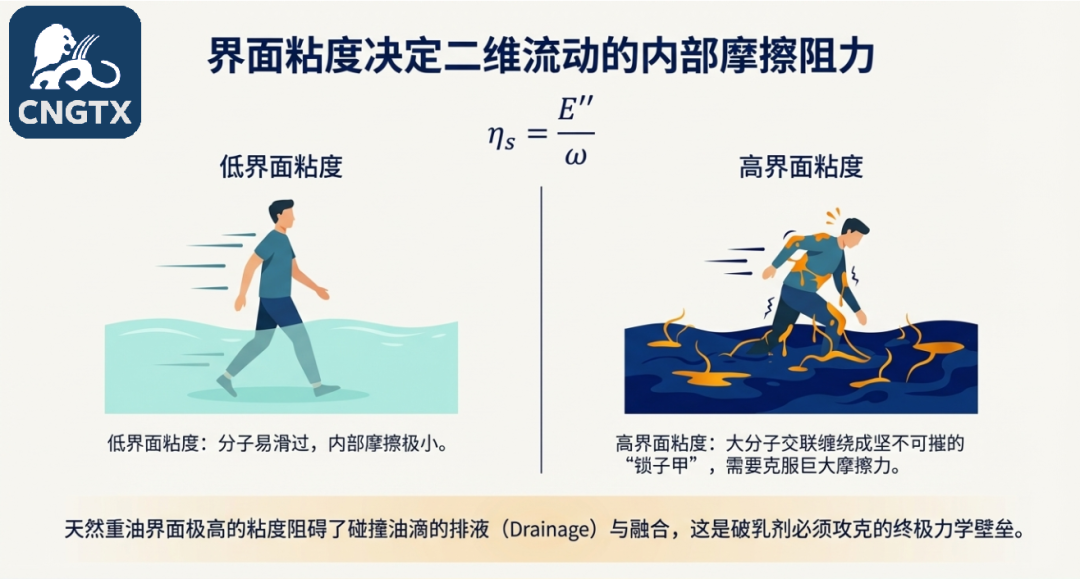
定义与机制:界面粘度反映了二维界面层在受到一定剪切或扩张形变速率时,抵抗流动的内部摩擦力大小。它与体系的特征振荡频率 (ω) 和损耗模量直接相关,其精确数学关系为:
Definition and Mechanism: Interfacial Viscosity reflects the magnitude of internal friction resisting flow within the two-dimensional interfacial layer when subjected to a certain rate of shear or dilational deformation. It is directly related to the system's characteristic oscillation frequency (ω) and the loss modulus, with the precise mathematical relationship being:
直观生活类比:在齐腰深的水中行走与在齐腰深的烂泥中跋涉。要理解这个概念,请想象两幅画面:第一幅,您在清澈的、齐腰深的游泳池水中行走。水流虽然产生阻力,但水分子很容易滑过您的身体,可以保持相对较快的步伐,因为水的内部摩擦力很小(低界面粘度)。第二幅,您不幸跌入了一片齐腰深的黑暗沼泽烂泥中。每一次抬腿、每一次向前迈步,粘稠的泥浆都紧紧吸附住您,需要你克服极其巨大的摩擦力才能移动分毫,步伐变得极其迟缓且极其耗费体力(极高界面粘度)。在油田深处,天然的原油(特别是重油)界面就像那片烂泥。大分子相互交联缠绕,形成了一层坚不可摧的“锁子甲”。极高的界面粘度使得原油乳液滴即使相互碰撞,界面膜也无法排液并融合,这是我们在设计破乳剂和化学驱油体系时必须攻克的终极力学壁垒。
Intuitive Everyday Life Analogy: Walking in Waist-Deep Water vs. Trudging Through Waist-Deep Mud. To understand this concept, imagine two scenarios: First, you are walking through clear, waist-deep water in a swimming pool. Although the water creates resistance, the water molecules easily slip past your body, and you can maintain a relatively brisk pace because the internal friction of the water is low (low Interfacial Viscosity). Second, you unfortunately fall into a waist-deep, dark swamp of thick mud. With every lift of your leg and every step forward, the sticky mud clings to you tightly, requiring you to overcome immensely massive frictional forces to move even an inch. Your progress becomes extraordinarily sluggish and exhausting (extremely high Interfacial Viscosity). Deep in the oilfield, the natural crude oil interface (especially heavy oil) is exactly like that swampy mud. Macromolecules cross-link and entangle, forming an impenetrable layer of "chainmail." An extremely high Interfacial Viscosity dictates that even when crude oil emulsion droplets collide, the interfacial film cannot undergo drainage to merge. This is the ultimate mechanical barrier we must overcome when designing demulsifiers and chemical flooding systems.

在深入解析了这些极为关键但晦涩难懂的微观物理概念之后,我们第二部分的探索也告一段落。我们已经确立了测量界面的“健康呼吸”状态对采油的决定性意义。但紧接着,系统工程学向我们抛出了下一个重大难题:在低于 10-2mN/m 的界面张力下,重力足以摧毁一切传统的流变学测量手段,我们究竟该用什么工程仪器来捕获这些瞬息万变的动态数据?这将是我们第三部分提供解决方案的核心所在。
Having deeply decoded these immensely critical yet obscure microscopic physical concepts, our exploration in Part 2 comes to a close. We have established that measuring the "healthy breathing" state of the interface holds decisive significance for oil extraction. However, immediately following this, system engineering throws the next major conundrum our way: under interfacial tensions of less than 10-2mN/m, gravity is sufficient to destroy all traditional rheological measurement methods. What engineering instrument can we possibly use to capture this fleeting, dynamic data? This will be the core focus of the solutions provided in our third part.
进入本系列文章的第三部分,我们将视野从理论力学转向精密的仪器工程学。既然我们已经认识到了解决提高原油采收率瓶颈必须依赖于界面扩张流变学属性,并且深刻理解了那些表征界面动态特性的参数,现在的关键是:提出切实可行的解决方案和测量策略。本部分将深入介绍一款颠覆性的设备——CNGTX旋转滴界面流变仪 (CNGTX Spinning Drop Interfacial Rheometer),并解释它如何定量化地改进我们的采油配方。
Entering the third part of this series, we shift our focus from theoretical mechanics to precision instrumental engineering. Since we have recognized that resolving the bottlenecks of Enhanced Oil Recovery mandates reliance on Interfacial Dilatational Rheology properties, and have profoundly understood the parameters characterizing dynamic interfacial traits, the key now is to present viable solutions and measurement strategies. This section will deeply introduce a disruptive device—the CNGTX Spinning Drop Interfacial Rheometer—and explain how it quantitatively refines our oil extraction formulations.