1. Li, Fei-Fei and World Labs Team, “A Functional Taxonomy of World Models: Renderers, Simulators, Planners, and the Loop That Connects Them,” 2026。文章按输出功能区分Renderer、Simulator与Planner,并说明可计算的几何、物理和动态结构如何连接视觉观察与行动后果。 World Labs原文 ↗
2. Anthropic Institute, “When AI builds itself,” 2026。文章讨论AI系统参与改进自身研究与工程流程时的进展、评测与风险边界。 官方文章 ↗
3. Mingguang Chen, Licheng Wang and Bo Qu, “Recursive Self-Improvement in AI: From Bounded Self-Refinement to Autonomous Research Loops,” arXiv:2607.07663, 2026。 论文 ↗
4. Moonshot AI, “Kimi K3,” 2026。官方页面把Game Dev与Digital Creation列为代表能力,并展示基于Three.js WebGPU的3D Open World案例;页面将其工作流描述为结合3D推理、编码、视觉理解与运行画面反馈。 官方页面 ↗
5. OpenAI, “GPT-5.6: Frontier intelligence that scales with your ambition,” 2026。官方页展示GPT‑5.6生成的3D帆船游戏;PlayCo报告,模型通过结构化API构建Unity场景时,相比直接工具调用减少63.5%的Token总量和50.1%的模型轮次。 官方页面 ↗
6. Anthropic, “Claude Fable 5 and Claude Mythos 5,” 2026。官方材料展示Fable 5从物理原理构建太阳系仿真、自主操作Factorio,以及在其创建的浏览器CAD中完成可3D打印模型。 官方页面 ↗
7. OpenAI Developers Showcase, “MiniTown,” GPT-5.6 + Codex. 链接 ↗
8. OpenAI Developers Showcase, “Material Lab,” GPT-5.6 + Codex. 链接 ↗
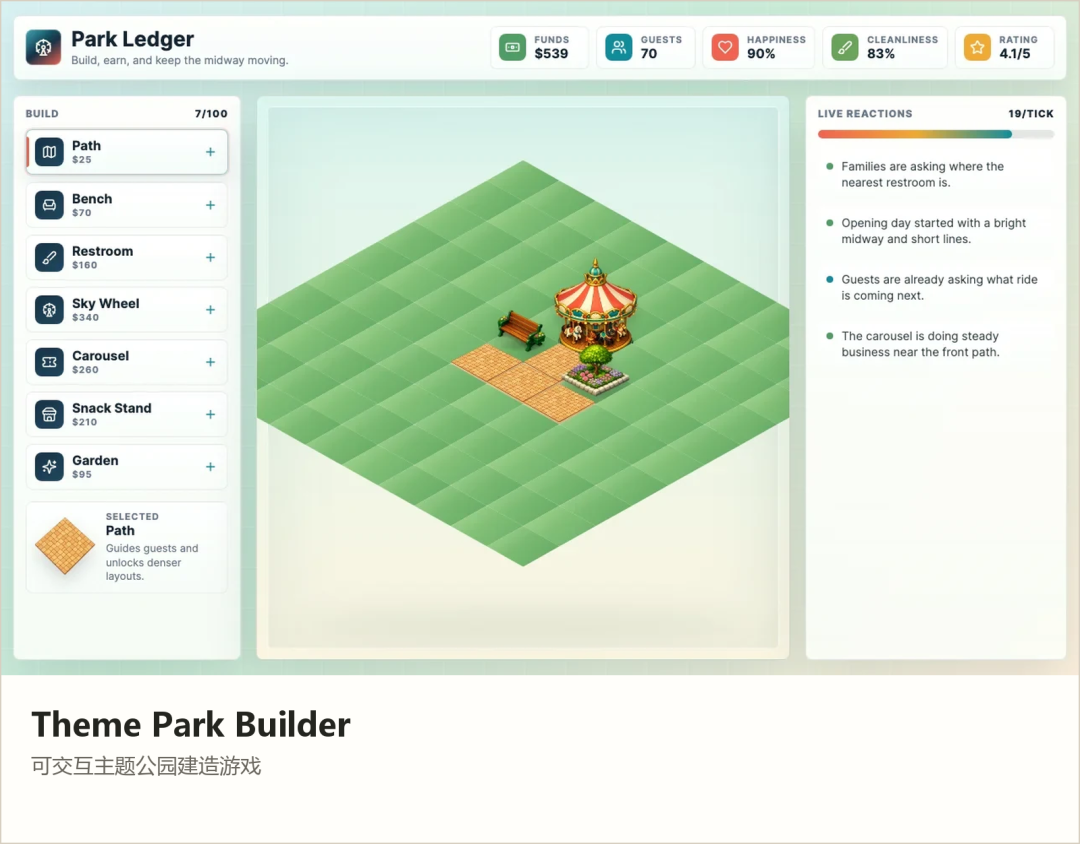
9. OpenAI Developers Showcase, “Theme Park Builder.” 链接 ↗
10. OpenAI Developers Showcase, “Biome Lab,” GPT-5.6 + Codex. 链接 ↗
11. OpenAI Developers Showcase, “Terrain Mixer,” GPT-5.6 + Codex. 链接 ↗
12. OpenAI Developers Showcase, “Procedural City Generator.” 链接 ↗
13. Danny Beijert转发的公开演示,“GPT-5.4 built a basically perfect Minecraft clone from scratch in 24 minutes — fully autonomous,” 2026。发布者称演示使用GPT-5.4、Codex与Playwright,从单次提示构建并自动试玩浏览器体素游戏;时间与流程为发布者自述。 公开视频 ↗
14. AI Andy / Dutch Startup, “I Gave Fable 5 Six Impossible Prompts (One Shot Each),” 2026。公开视频展示作者所称的单提示GTA式开放城市与移动端拉力原型;“47分钟”等数据属于作者测试口径。 原视频 ↗文字说明 ↗
15. Reddit用户Grenagar,“Built a full 3D browser game using Claude Code — Traffic Architect,” 2026。作者说明项目使用Claude Code与Three.js,全部场景资产由代码生成,同时强调规划、审阅、小步任务和数月迭代。 公开视频与复盘 ↗
16. Reddit用户DriftClub_gg,“Built a browser car racing game with Claude Code,” 2026。作者说明车辆物理运行在Three.js上,并明确称项目经过约三个月兼职开发、多轮提示与试错。 公开视频与复盘 ↗
17. OpenAI Developers Showcase, “Backroom Center: Corrupted.” 链接 ↗
18. Three.js, “Scene Graph” and “Object3D.” Three.js以对象层级、变换、材质与WebGL渲染构成代码优先的浏览器三维运行时。 官方手册 ↗
19. BlenderMCP, “Open-source MCP to use Blender with any LLM.” 社区项目通过Blender插件与MCP服务器提供场景查询、对象和材质操作、视口截图及Python执行。 代码 ↗
20. Blender Foundation, “Command Line Arguments.” Blender支持无界面运行、执行Python脚本、渲染、保存和导出。 官方文档 ↗
21. CoplayDev, “MCP for Unity”; Wu and Barnett, “MCP-Unity: Protocol-Driven Framework for Interactive 3D Authoring,” SIGGRAPH Asia Technical Communications 2025. 该项目把场景、资产、脚本和测试暴露给Claude、Codex等MCP客户端。 代码与论文信息 ↗
22. Epic Games, “Unreal MCP in Unreal Editor,” Unreal Engine 5.8 Documentation. 实验性插件在编辑器内嵌MCP服务器,可供Codex、Claude Code、Cursor等客户端调用Actor、灯光、材质与自动化测试工具。 官方文档 ↗
23. McNeel, “Compute: Features.” Rhino Compute通过无状态REST API提供Grasshopper求解和2,400余项RhinoCommon几何运算,并支持C#、Python与JavaScript客户端。 官方文档 ↗
24. SideFX, “Houdini Object Model” and “Command-Line Scripting.” HOM允许Python查询和控制Houdini,hython可在命令行加载、检查和修改HIP场景。 HOM文档 ↗命令行文档 ↗
25. Autodesk, “3ds Max Developer Help.” 3ds Max提供原生MAXScript、Python pymxs API和C++ SDK,用于场景操作、工具开发与管线自动化。 官方文档 ↗
26. Anthropic official video, “Claude Fable 5 simulates the solar system.” 链接 ↗
27. Anthropic official video, “Claude Fable 5 autonomously plays Factorio.” 链接 ↗
28. Anthropic official video, “Claude Fable 5 builds a browser CAD editor and 3D-printable model.” 链接 ↗
29. Google DeepMind, “Genie 3: A new frontier for world models,” 2025。官方页面报告由文本实时生成可交互世界,输出为720p、20–24fps并支持数分钟连续交互,同时列出长期一致性与有限动作空间等限制。 官方页面 ↗
30. World Labs, “Marble: A Multimodal World Model.” 链接 ↗
31. Odyssey, “Introducing interactive video.” 链接 ↗
32. Manifold AI, “WorldScape.” 链接 ↗
33. World Labs, “3D as code.” 链接 ↗
34. World Labs, “Marble Documentation.” 官方文档报告标准World通常约5分钟完成,并列出Draft、World与高质量Mesh的预计时间;服务条款同时提示,生成的三维世界未必准确反映真实物理、尺寸或空间关系。 生成时间 ↗输出边界 ↗
35. Kang et al., “SimWorld Studio: Automatic Environment Generation with Evolving Coding Agent for Embodied Agent Learning,” 2026. 链接 ↗
36. Lu et al., “WorldCoder-Bench: Benchmarking Physically Grounded 3D World Synthesis,” 2026. 链接 ↗
37. Rodionov et al., “FloorplanQA: A Benchmark for Spatial Reasoning in LLMs using Structured Representations,” 2025/2026. 链接 ↗
38. Li, Fei-Fei and World Labs Team, “A Functional Taxonomy of World Models: Renderers, Simulators, Planners, and the Loop That Connects Them,” 2026. 文章按输出功能区分Renderer、Simulator与Planner,并强调模拟所提供的几何、物理和动态结构是连接视觉观察与行动后果的关键。 World Labs原文 ↗中文介绍 ↗
39. Song et al., “SceneOrchestra: Agentic Planning and Tool Use for Long-Horizon Indoor Scene Generation,” 2026. 论文在统一A6000环境中报告LayoutGPT、Holodeck、SceneWeaver与SceneOrchestra的平均运行时间。 论文 ↗
40. 小红书传播案例,“GPT‑5.6硬控Blender,盘点AI建模玩法”,2026。该材料用于观察LLM接入本地图形软件的传播现象,不作为性能或模型版本的独立验证。 原帖链接 ↗
41. Luo et al., “GameCraft-Bench: Can Agents Build Playable Games End-to-End in a Real Game Engine?” 2026. 链接 ↗
42. Kraus et al., “Agentic Video Generation: From Text to Executable Event Graphs via Tool-Constrained LLM Planning,” 2026. 链接 ↗
43. Pfaff et al., “SceneSmith: Agentic Generation of Simulation-Ready Indoor Scenes,” ICML 2026 Spotlight. 分层VLM代理生成可分离、带物理属性并可用于机器人仿真的室内场景。 项目页 ↗论文 ↗
44. Yang et al., “Code-as-Room: Generating 3D Rooms from Top-Down View Images via Agentic Code Synthesis,” 2026。官方项目页公开输入俯视图与VIGA基线的Blender转台视频对照;正文并排保留原始输入与官方基线输出,用于观察对象遗漏、占位化、尺度与布局退化。 官方项目页与视频 ↗论文 ↗
45. Feng et al., “LayoutGPT: Compositional Visual Planning and Generation with Large Language Models,” NeurIPS 2023。论文补充材料的Figure 11展示三维室内布局中的家具越界、对象重叠和不协调摆放;随机选取8个卧室上下文示例时,越界率由43.26%升至85.58%。 项目页 ↗论文 ↗
46. fit_liger8646, “Blender×MCP:自然语言生成三维角色实测,” 2026. 三视图角色在自动建模中被近似为大量球体与圆柱,显示有机曲面、部件结构与拓扑恢复仍不稳定。 实测记录 ↗
47. JellyAI, “Blender MCP自然语言建模实测,” 2025. 测试覆盖房间、茶壶和四椅组合;复杂任务出现悬浮、比例失真、朝向与位置混乱,并需要拆分为连续小步骤。 实测记录 ↗
48. Reddit r/vibecoding, “New level: Vibe-modeling/animation in 3D,” 2026. 用户复盘Claude Code与Blender MCP修改角色网格时误伤牙齿和相邻部件,导致既有模型关系被破坏。 用户复盘 ↗
49. Yann LeCun, “A Path Towards Autonomous Machine Intelligence,” OpenReview, 2022。文章提出由感知、世界模型、代价、短期记忆与行动模块组成的自主机器架构。 论文 ↗
50. Meta AI, “V-JEPA 2: Self-Supervised Video Models Enable Understanding, Prediction and Planning,” 2025。模型从视频学习物理世界表征,并用于理解、预测与机器人规划。 论文 ↗官方介绍 ↗
51. Feng et al., “LayoutGPT: Compositional Visual Planning and Generation with Large Language Models,” 2023. 链接 ↗
52. Yang et al., “Holodeck: Language Guided Generation of 3D Embodied AI Environments,” CVPR 2024. 链接 ↗
53. Bian, Ren, Yang and Callison-Burch, “HOLODECK 2.0: Vision-Language-Guided 3D World Generation with Editing,” arXiv:2508.05899, 2025. 论文 ↗
54. Avetisyan et al., “SceneScript: Reconstructing Scenes With An Autoregressive Structured Language Model,” 2024. 链接 ↗
55. Li et al., “HDSL: A Hierarchical Domain-Specific Language for Structured 3D Indoor Scene Generation and Localized Editing with LLM Agents,” 2026. 链接 ↗
56. Zhang et al., “The Scene Language: Representing Scenes with Programs, Words, and Embeddings,” CVPR 2025. 论文 ↗
57. Gumin et al., “Procedural Scene Programs for Open-Universe Scene Generation: LLM-Free Error Correction via Program Search,” SIGGRAPH Asia 2025. 论文 ↗
58. Jiang et al., “HOG-Layout: Hierarchical 3D Scene Generation, Optimization and Editing via Vision-Language Models,” CVPR 2026. 论文 ↗
59. Wang et al., “Function2Scene: 3D Indoor Scene Layout from Functional Specifications,” 2026. 论文 ↗
60. NVIDIA, “OpenUSD for Developers.” 链接 ↗
61. Kundu et al., “Kubric: A scalable dataset generator,” 2022. 链接 ↗
62. ASAM, “OpenSCENARIO DSL,” dynamic scenario description standard, v2.2.0, 2026. 标准 ↗
63. Gu et al., “ConceptGraphs: Open-Vocabulary 3D Scene Graphs for Perception and Planning,” 2023. 链接 ↗
64. Rana et al., “SayPlan: Grounding Large Language Models using 3D Scene Graphs for Scalable Robot Task Planning,” CoRL 2023. 链接 ↗
65. Huang et al., “VoxPoser: Composable 3D Value Maps for Robotic Manipulation with Language Models,” CoRL 2023. 项目页 ↗
66. 生境科技研究稿,“VisAlign: Aligning Multimodal Interior Design Reasoning with Scene Visualization Feedback,” 2026。 研究稿 ↗
67. 生境科技研究稿,“HiSQ-Bench: Benchmarking Human-Centric Spatial Quality in Indoor Scene Generation,” 2026。 研究稿 ↗
68. Yang et al., “OptiScene: LLM-driven Indoor Scene Layout Generation via Scaled Human-aligned Data Synthesis and Multi-Stage Preference Optimization,” 2025. 链接 ↗
69. Sun et al., “LayoutVLM: Differentiable Optimization of 3D Layout via Vision-Language Models,” CVPR 2025. 论文 ↗
70. Liu et al., “Controllable 3D Outdoor Scene Generation via Scene Graphs,” ICCV 2025. 论文 ↗
71. Fu et al., “AnyHome: Open-Vocabulary Generation of Structured and Textured 3D Homes,” 2023. 链接 ↗
72. Gao et al., “GraphDreamer: Compositional 3D Scene Synthesis from Scene Graphs,” 2023. 链接 ↗
73. Lin and Mu, “InstructScene: Instruction-Driven 3D Indoor Scene Synthesis with Semantic Graph Prior,” 2024. 链接 ↗
74. Zhou et al., “GALA3D: Towards Text-to-3D Complex Scene Generation via Layout-guided Generative Gaussian Splatting,” 2024. 链接 ↗
75. Huang et al., “Toward Scene Graph and Layout Guided Complex 3D Scene Generation,” 2024. 链接 ↗
76. Yang et al., “SceneCraft: Layout-Guided 3D Scene Generation,” 2024. 链接 ↗
77. Zhou et al., “LAYOUTDREAMER: Physics-guided Layout for Text-to-3D Compositional Scene Generation,” 2025. 链接 ↗
78. Zhou et al., “RoomCraft: Controllable and Complete 3D Indoor Scene Generation,” 2025. 链接 ↗
79. Lin et al., “GenUSD: 3D Scene Generation Made Easy,” SIGGRAPH 2024 Real-Time Live. 链接 ↗
80. Lara et al., “Generative Floor Plan Design with LLMs via Reinforcement Learning with Verifiable Rewards,” 2026. 链接 ↗
81. Sengupta et al., “SceneCritic: A Symbolic Evaluator for 3D Indoor Scene Synthesis,” 2026 preprint. 链接 ↗
82. Frühwirth et al., “Word2Minecraft: Generating Playable Minecraft Worlds from Structured Stories,” 2025. 链接 ↗
83. Dream‑Cubed, direct generation of Minecraft worlds from tens of billions of cube tokens, 2026. 链接 ↗
84. 生境科技内部工程记录与产品演示,2026:现有工程链路已实现20秒级空间状态增量解算。该结果是已完成的内部工程能力;跨系统性能比较仍需在同输入、同资产、同硬件和同质量阈值下建立公开Benchmark。
85. 生境科技研究稿,“SceneHub: Synthesizing High‑Variability Interior Data through User Collaboration,” 2026。 研究稿 ↗
86. 生境科技,《森盒二测商业价值数据报告》,2026年内部研究材料;统计来自二测原始数据表交叉计算,测试环境经济行为不等同于真实支付。
87. World Labs, “Scaling Robotic Simulation with Marble,” 2025;以及Lightwheel的real‑to‑sim评估案例。两项案例展示从真实场景构建可控三维世界,用于机器人策略训练、弱点搜索与评估。 机器人仿真案例 ↗Real‑to‑sim案例 ↗
88. 生境科技研究稿,“Neuro‑Spectral Fields: Bridging Semantic Intent and Geometry via Physics‑Informed Operators,” 2026。 研究稿 ↗
89. Bai et al., “Qwen2.5‑VL Technical Report,” 2025. 模型支持开放视觉识别、对象框/点定位、文档与布局理解及结构化信息抽取。 论文 ↗
90. Ravi et al., “SAM 2: Segment Anything in Images and Videos,” 2024. SAM‑2提供图像与视频中的可提示对象分割,并支持点、框与mask等交互提示。 论文 ↗
91. Oquab et al., “DINOv2: Learning Robust Visual Features without Supervision,” 2023. DINOv2通过自监督训练提供可跨图像与像素级任务复用的通用视觉特征。 论文 ↗
92. Zhai et al., “Sigmoid Loss for Language Image Pre‑Training,” ICCV 2023;Radford et al., “Learning Transferable Visual Models From Natural Language Supervision,” 2021. SigLIP与CLIP将图像和文本编码到可比较的语义空间。 SigLIP论文 ↗CLIP论文 ↗
93. 陶大程 / 大晓机器人,“世界模型的使命不是完整复制世界,而是精准支撑行动”,InfoQ转载,2026。 链接 ↗
94. Li et al., “HomeWorld: A Unified Floorplan‑to‑Furnished Framework for Generating Controllable, Densely Interactive Whole‑Home Scenes,” 2026. 论文 ↗项目页 ↗
95. Wu et al., “SceneGraphFusion: Incremental 3D Scene Graph Prediction from RGB‑D Sequences,” CVPR 2021. 链接 ↗
96. Rosinol et al., “Kimera: From SLAM to Spatial Perception with 3D Dynamic Scene Graphs,” 2021. 链接 ↗
97. Hughes et al., “Hydra: A Real‑time Spatial Perception System for 3D Scene Graph Construction and Optimization,” 2022. 链接 ↗
98. Werby et al., “Hierarchical Open‑Vocabulary 3D Scene Graphs for Language‑Grounded Robot Navigation,” 2024. 链接 ↗
99. Yan et al., “Dynamic Open‑Vocabulary 3D Scene Graphs for Long‑term Language‑Guided Mobile Manipulation,” 2024. 链接 ↗
100. Rajvanshi et al., “SayNav: Grounding Large Language Models for Dynamic Planning to Navigation in New Environments,” 2023. 链接 ↗
101. Liu et al., “OK‑Robot: What Really Matters in Integrating Open‑Knowledge Models for Robotics,” 2024. 项目页 ↗
102. Kim and Kim, “OP3DSG: Open‑Vocabulary Part‑Aware 3D Scene Graph Generation for Real‑World Environments,” 2026 preprint. 链接 ↗
103. Fujitsu Research, “Spatial World Model.” 链接 ↗
104. 财新,“大晓机器人完成天使+轮融资,2026年上半年累计融资数亿美元”,2026‑06‑15。 链接 ↗
105. Allen Institute for AI, “AI2‑THOR Environment State and Object Metadata.” 链接 ↗
106. Puig et al., “VirtualHome: Simulating Household Activities via Programs,” project and open‑source simulator. 链接 ↗
107. Allen Institute for AI, “ProcTHOR.” 链接 ↗
108. AI Habitat, embodied AI simulation platform. 链接 ↗
109. AI Habitat, “Habitat 3.0: A Co‑Habitat for Humans, Avatars and Robots.” 链接 ↗
110. AI Habitat, “ReplicaCAD Dataset.” 链接 ↗
111. AI Habitat, “Habitat‑Matterport 3D Dataset.” 链接 ↗
112. Stanford Vision and Learning Lab, “BEHAVIOR‑1K.” 链接 ↗
113. Xiang et al., “SAPIEN: A SimulAted Part‑based Interactive ENvironment,” CVPR 2020; ManiSkill platform. 项目页 ↗
114. NVIDIA, “Isaac Sim: Robotics Simulation and Synthetic Data Generation.” 链接 ↗
115. DLR‑RM, “BlenderProc2: A Procedural Pipeline for Photorealistic Rendering.” 代码与文档 ↗
116. SimWorld Studio official project page. 链接 ↗
117. NVIDIA, “Omniverse: Develop Physical AI Applications.” 链接 ↗
118. Siemens, “AI‑driven Industrial World Modeling,” PLANET of MIMICS Research Radar. 链接 ↗
119. NVIDIA, “Cosmos World Foundation Models and Physical AI Data Tools,” 2025. 链接 ↗
120. Niantic Spatial, “Large Geospatial Model,” 2024. 链接 ↗
121. CARLA Simulator, open‑source autonomous driving simulation platform. 链接 ↗
122. Fremont et al., “Scenic: A Language for Scenario Specification and Data Generation,” 2020; official language site. 链接 ↗
123. Li et al., “ScenarioNet: Open‑Source Platform for Large‑Scale Traffic Scenario Simulation and Modeling,” 2023. 链接 ↗
124. Li et al., “MetaDrive: Composing Diverse Driving Scenarios for Generalizable Reinforcement Learning,” 2021. 链接 ↗
125. Waabi, “How Waabi World Works.” 链接 ↗
126. Applied Intuition, “Products: Simulation, Evaluation and Physical AI Platform.” 链接 ↗
127. Foretellix, “Foretify Testing and Verification Platform.” 链接 ↗
128. Parallel Domain, “PD Replica and PD Sim.” 链接 ↗
129. Wu et al., “WorldReasonBench: Human‑Aligned Stress Testing of Video Generators as Future World‑State Predictors,” 2026. 链接 ↗
130. OpenAI, “Introducing the Codex app,” 2026. 链接 ↗
131. Hu et al., “SceneCraft: An LLM Agent for Synthesizing 3D Scenes as Blender Code,” ICML 2024. 系统以场景图规划关系,将关系转为数值约束和Blender Python脚本,再用视觉语言模型检查渲染结果并迭代修正;论文展示了包含约百个三维资产的复杂场景。 论文 ↗
132. World Labs, “API Pricing.” 标准World生成1,500 credits,Draft生成150 credits;输入类型另有附加credits。 官方计价 ↗
133. Yang et al., “Holodeck: Language Guided Generation of 3D Embodied AI Environments,” CVPR 2024 Supplementary Material. 补充材料报告单房间原始实现约3分钟、GPT‑4 API成本约0.2美元。 补充材料 ↗
134. Reddit r/ClaudeAI, “I tested Claude + Blender MCP for real 3D workflows,” 2026. 用户测试显示简单房间可快速生成,但复杂网格清理尚未达到生产标准,且完整过程包含多次失败尝试。 用户复盘 ↗
135. ahujasid/blender‑mcp issue tracker and user reports, 2026. 公开问题集中在调用超时、连接中断、不完整JSON、视口异常与状态恢复。 Issue 279 · Issue 264 · Issue 256 · 用户复盘
136. “Agent Augmented 3D Modeling: A Planner‑Actor‑Critic Framework,” arXiv:2601.05016, 2026. 研究以规划、执行和批评回路组织三维操作,反映单次脚本直出正在转向带状态检查的长程代理。 论文 ↗
137. World Labs, “Announcing the World API.” 链接 ↗
138. ACE Robotics / SenseTime, Kairos 3.0 world model. 链接 ↗
139. GigaWorld Team, “GigaWorld‑0: World Models as Data Engine to Empower Embodied AI,” 2025. 链接 ↗
140. Field AI, “Field Foundation Models / Belief World Model.” 链接 ↗
141. SpatialVerse official site. 链接 ↗
142. Manycore Research. 链接 ↗
143. Fang et al., “iWorld‑Bench: A Benchmark for Interactive World Models,” 2026. 链接 ↗
144. Hopkins et al., “Factorio Learning Environment,” 2025. 链接 ↗
145. Gu et al., “BlenderGym: Benchmarking Foundational Model Systems for Graphics Editing,” CVPR 2025 Highlight. 基准包含245个手工构造的Blender编辑任务,覆盖程序化几何、灯光、程序化材质、形变与对象摆放;论文与补充材料报告前沿VLM在细微差异识别、正确属性修改和可执行脚本生成上仍存在系统性失败。 项目页 ↗论文 ↗失败案例 ↗
146. Yang et al., “SceneCraft: Layout‑Guided 3D Scene Generation,” 2024。补充材料Figure E、F报告两类场景合成失败:对象过密与边界框高度重叠时几何无法收敛;房间布局与提示语义不匹配时难以生成合适内容。 项目页 ↗论文 ↗
147. Ling et al., “Scenethesis: A Language and Vision Agentic Framework for 3D Scene Generation,” ICLR 2026。项目页明确说明,直接使用规划场景图会因检索资产与视觉对象的尺寸、姿态差异产生错位、穿插和不稳定,因此需追加物理优化与空间一致性审阅。 项目页与视频 ↗论文 ↗
148. Fan et al., “MAGIC: Transition‑Aware Generation of Navigable Multi‑Scene Game Worlds with Large Language Models,” 2026。100例多场景基准把连接一致性、场内可达性和真实传送执行纳入验证;论文报告直接LLM基线生成的Unity项目没有一个可直接执行,HOLODECK也频繁漏门并受到高场景占用率影响。 论文 ↗代码 ↗
149. Alaya Lab, “AlayaWorld: Long‑Horizon and Playable Video World Generation,” 2026。官方项目页提供同一左右转与回看轨迹下的四方法视频对比,可用于观察感知式世界生成中的跨视角记忆漂移。 官方项目页与对比视频 ↗
150. Moonshot AI, “Kimi K2,” 2026。官方页面展示浏览器Minecraft式3D体素世界,包含程序化地形、树木与Canvas生成的方块纹理。 官方页面 ↗
151. Google, “Gemini 3: Introducing the latest Gemini AI model from Google,” 2025。官方发布材料展示复古3D飞船游戏、体素美术和可玩的科幻世界,用于说明模型把自然语言、代码与交互界面连成可运行结果。 官方页面 ↗
152. OpenAI, “Introducing GPT‑5.3‑Codex,” 2026。官方案例包括赛车与潜水游戏,并说明高质量结果来自跨多轮、数百万Token的自主迭代;这表明“一句话”通常是任务入口而非单次推理。 官方页面 ↗




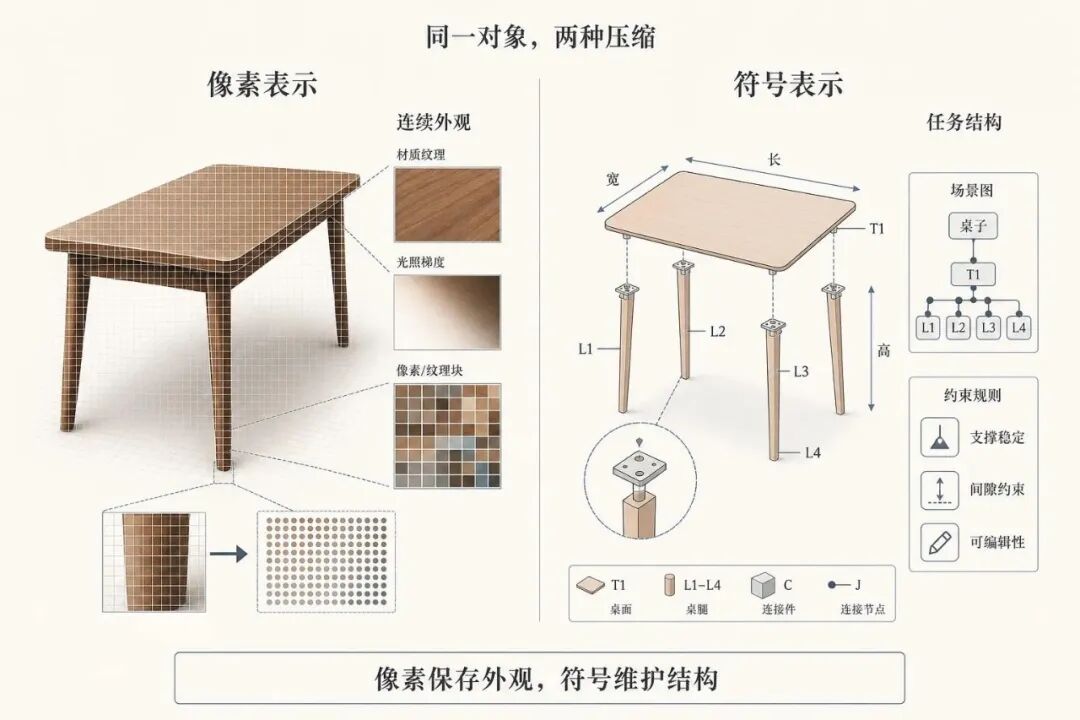

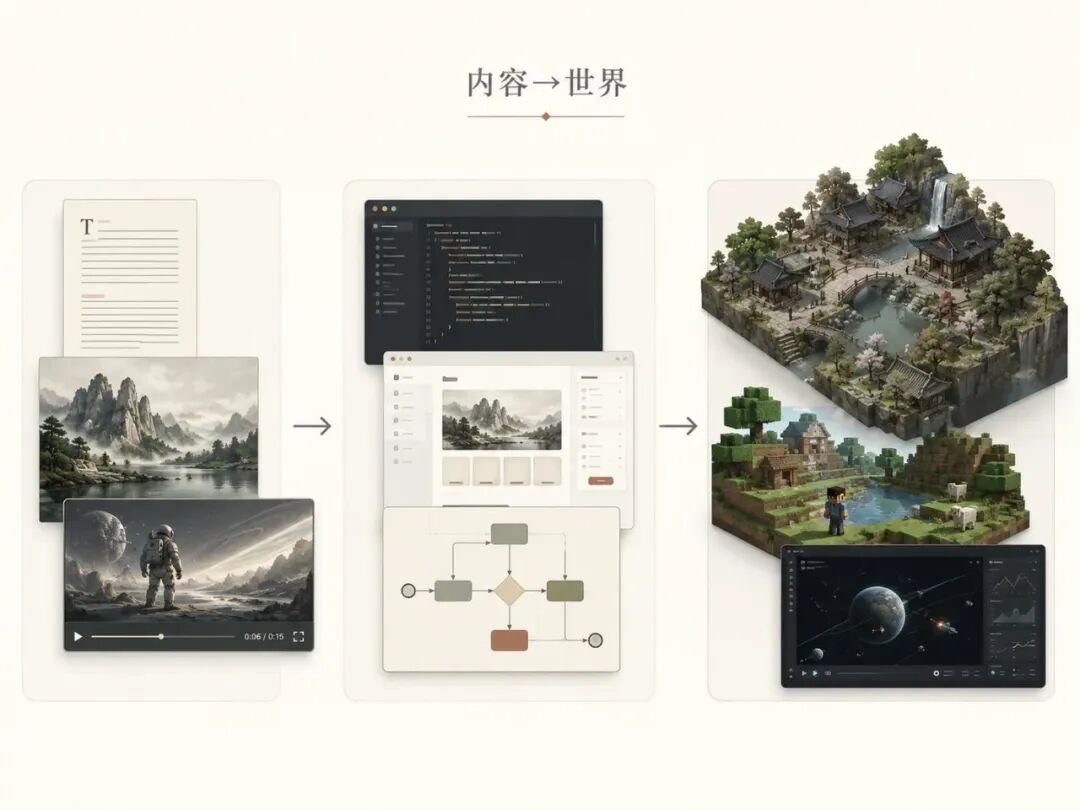


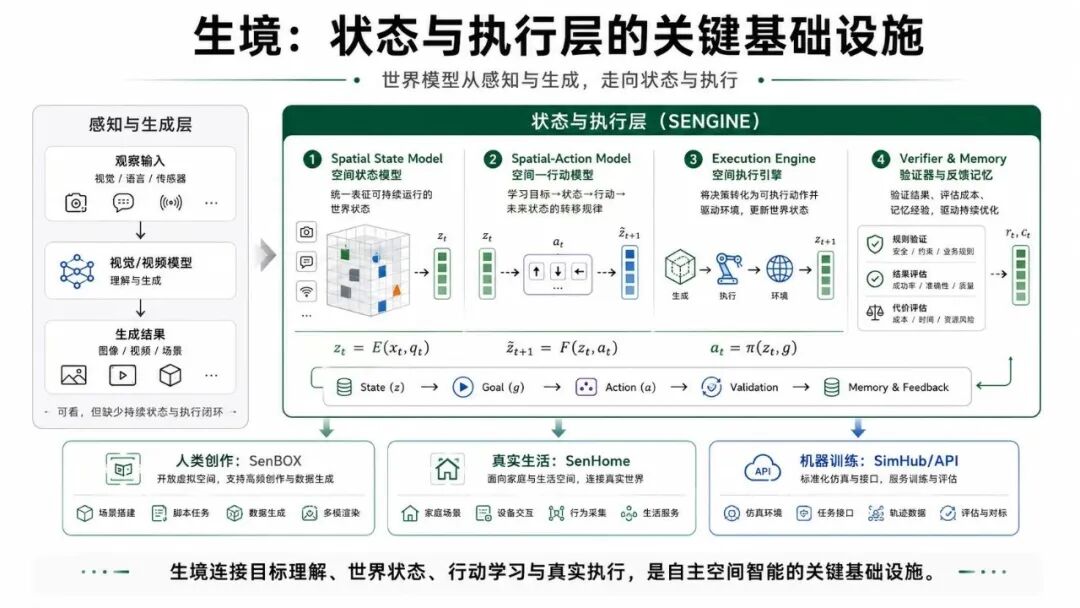
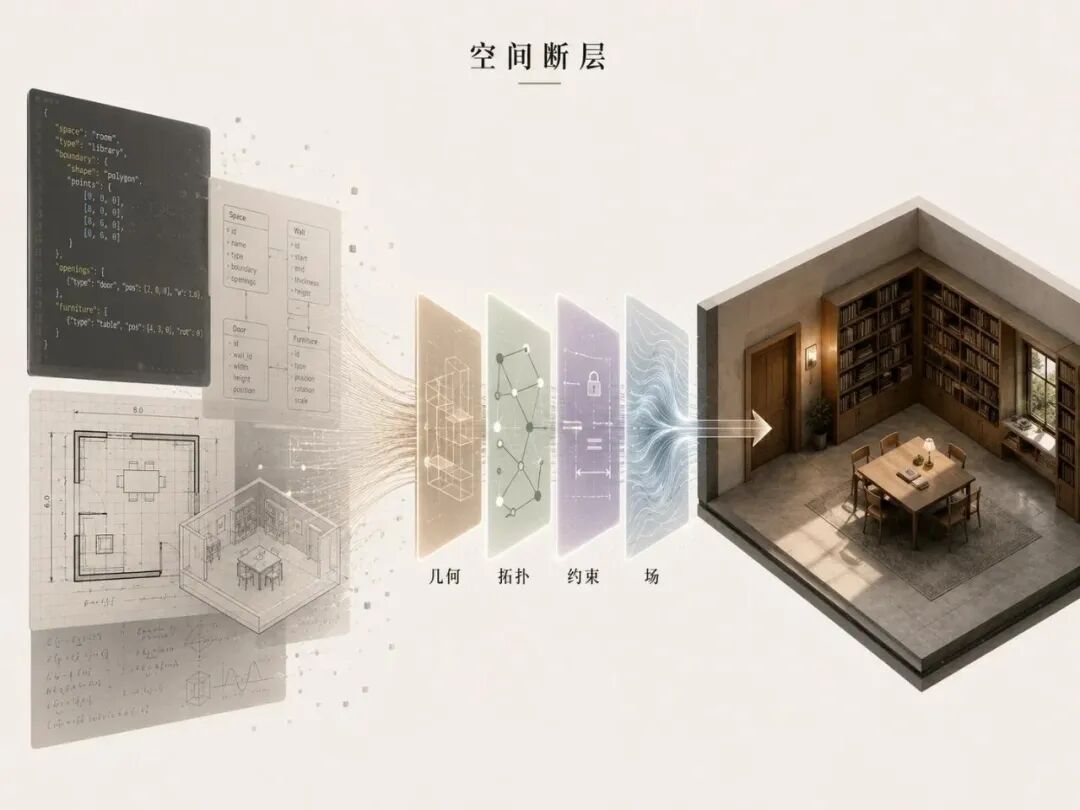 场景中间层将对象、几何、关系与约束组织为可寻址状态,并为后续求解、执行与验证提供统一接口。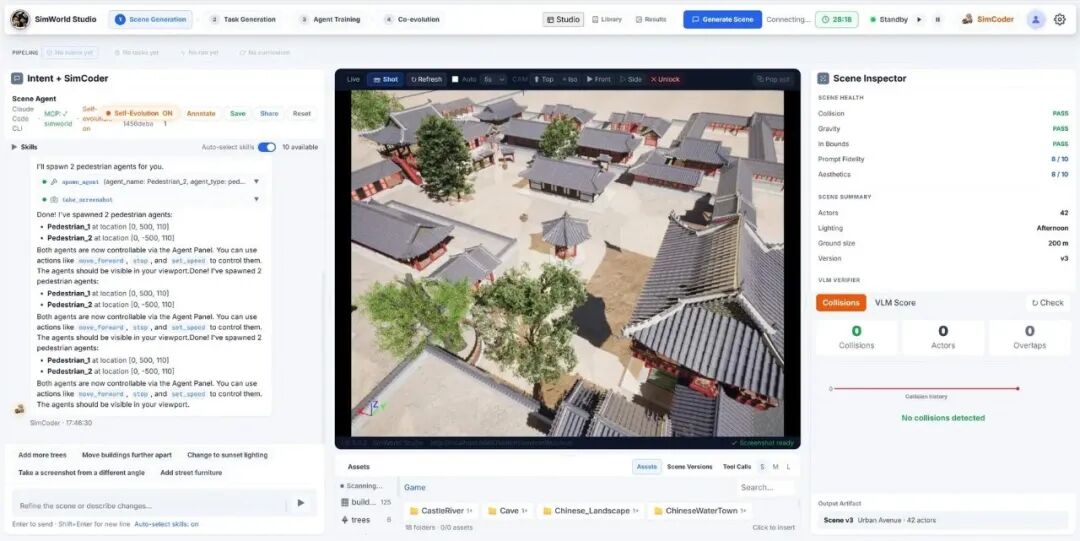

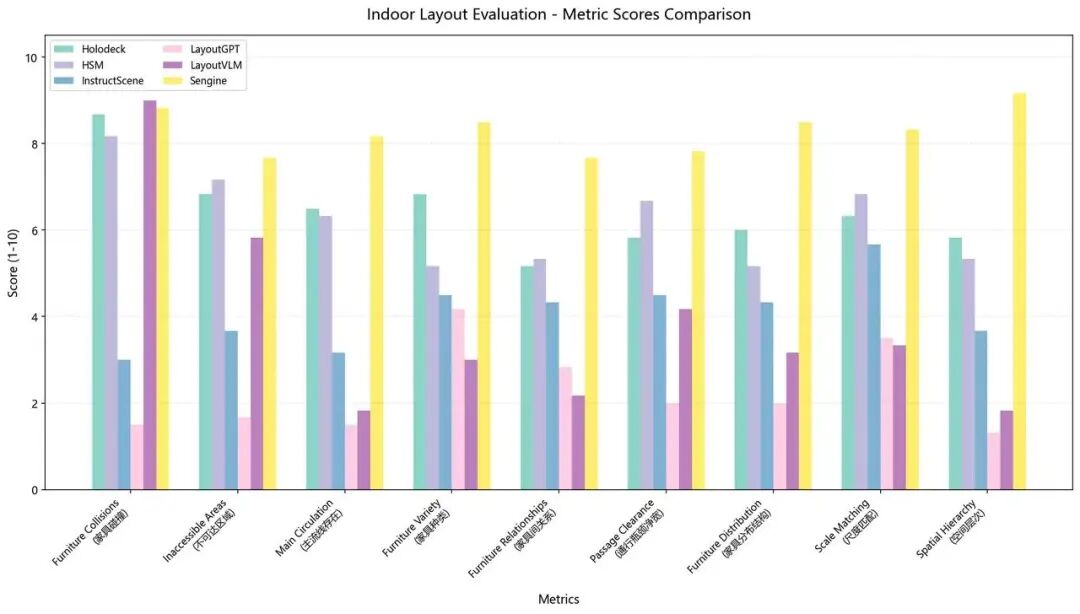
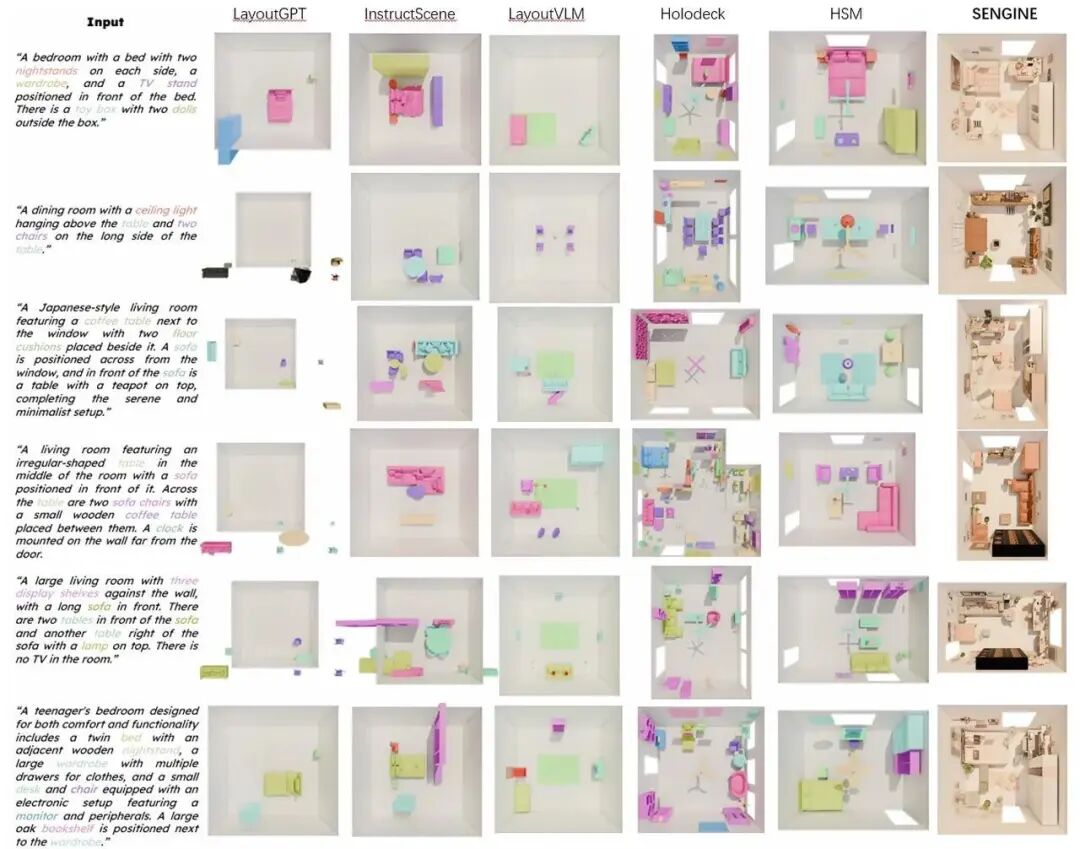 相同指令下的布局对比:生境在空间完整性、对象关系与可用性上表现更稳定。

 生境将真实交互与 Rollout 持续回流训练,形成不断改进的空间智能闭环。