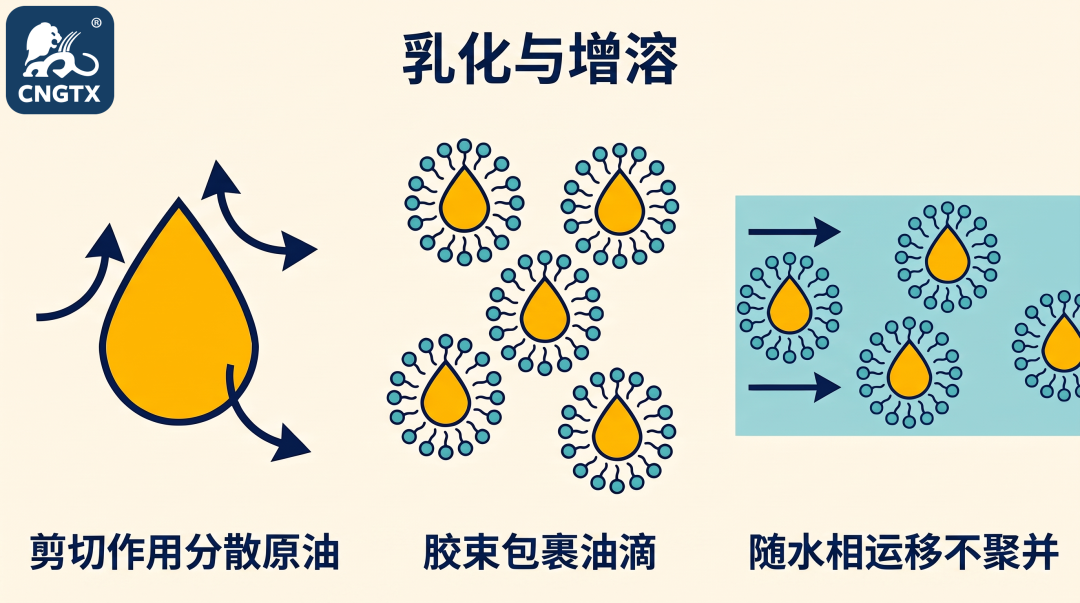
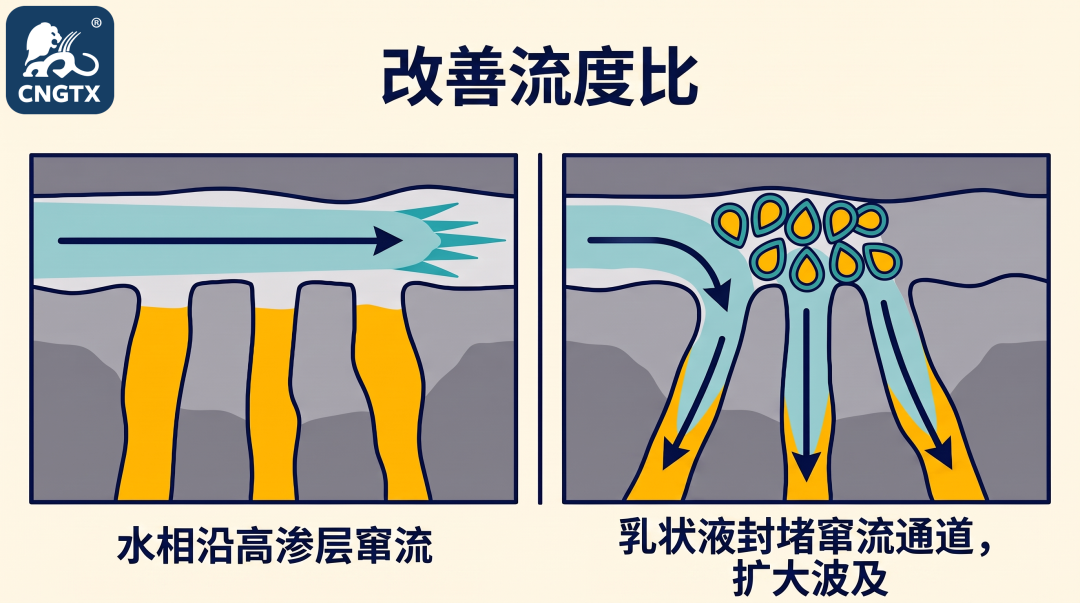
Part 2: Five Displacement Mechanisms and Ultra-Low IFT Measurement承接第一部分关于表面活性剂驱油宏观背景与应用潜力的讨论,第二部分将开启一段深入地层孔喉微观物理化学环境的探索之旅。在这里,我们将直面原油被困的微观挑战,详细剖析表面活性剂独特的两亲性分子结构如何诱发五大核心驱油机制,并解析当代实验室用于测量超低界面张力的精密仪器及其测试原理。Following the discussion in Part 1 regarding the macro-background and application potential of surfactant flooding, Part 2 embarks on a journey exploring the microscopic physiochemical environment deep within formation pore throats. Here, we will confront the microscopic challenges of trapped crude oil, meticulously analyze how the unique amphiphilic molecular structure of surfactants induces five core oil-displacement mechanisms, and examine the precision instruments and measurement principles used in contemporary laboratories to measure ultra-low interfacial tension.在微观尺度下,原油与地层水、岩石矿物表面之间存在着极其复杂的相态热力学平衡。表面活性剂驱油能够打破这种平衡,其核心效能完全源于其独特的“两性分子结构”:分子的其中一端是极性的亲水头基(如磺酸基、羧基等),而另一端则是非极性的疏水(亲油)尾部碳氢长链。当这种化学剂被注入储层后,由于极性和非极性基团在极性溶剂(水)中的热力学不稳定性,表面活性剂分子会自发向体系的相界面(气-水、油-水或固-液界面)迁移,并在此定向排列形成紧密的单分子吸附膜。正是这种自组装行为改变了界面的物理化学性质,触发了以下五个维度的核心驱油机理。At the microscopic scale, an exceedingly complex phase thermodynamic equilibrium exists among crude oil, formation water, and rock mineral surfaces. Surfactant flooding can disrupt this equilibrium, and its core efficacy originates entirely from its unique "amphiphilic molecular structure": one end of the molecule is a polar hydrophilic head group (such as sulfonate, carboxylate, etc.), while the other end is a non-polar hydrophobic (lipophilic) long hydrocarbon tail. When such chemicals are injected into a reservoir, due to the thermodynamic instability of polar and non-polar groups in a polar solvent (water), the surfactant molecules spontaneously migrate toward the system's phase interfaces (gas-water, oil-water, or solid-liquid interfaces), where they orient themselves to form a dense monomolecular adsorption film. It is this self-assembly behaviour that alters the physicochemical properties of the interfaces, triggering core oil-displacement mechanisms across the following five dimensions.(1)大幅降低油水界面张力(IFT)——克服毛细管力的最核心机理。在经历水驱之后,未波及的残余油被极强的毛细管力困在孔喉中,此时纯水与原油间的界面张力通常维持在20至30 mN/m的高位。表面活性剂分子在油水界面的高度富集,能够通过两亲分子置换界面上的溶剂分子,使界面张力下降数个数量级,达到 10⁻³ 甚至 10⁻⁴ mN/m 的“超低界面张力”区间。流体力学中通过无量纲的毛细管数(Capillary Number, Nc = Vμw / σwo,其中V为驱替速度,μw为驱替液黏度,σwo为界面张力)来衡量驱油效率。超低界面张力能够使毛细管数提高三到四个数量级(达到 10⁻³ 至 10⁻²),极大地抵消了毛细管阻力,使原本被束缚的残余油滴发生弹性变形,从而拉长成油线,顺畅穿过狭窄的岩石孔喉被水相驱替出来。(1) Substantially reduce the oil–water interfacial tension (IFT) — the most critical mechanism for overcoming capillary forces. After experiencing waterflooding, the unswept residual oil is trapped in pore throats by extremely strong capillary forces, with the interfacial tension between pure water and crude oil typically maintained at a high level of 20 to 30 mN/m. The high enrichment of surfactant molecules at the oil-water interface allows the amphiphilic molecules to displace solvent molecules at the interface, causing a multi-order-of-magnitude reduction in interfacial tension, reaching the "ultra-low interfacial tension" regime of 10⁻³ or even 10⁻⁴ mN/m. In fluid mechanics, displacement efficiency is measured by the dimensionless capillary number (Nc = Vμw / σwo, where V is displacement velocity, μw is displacing fluid viscosity, and σwo is interfacial tension). Ultra-low interfacial tension can increase the capillary number by three to four orders of magnitude (reaching 10⁻³ to 10⁻²), massively counteracting capillary resistance, allowing previously immobile residual oil droplets to undergo elastic deformation, stretch into oil threads, and smoothly pass through narrow rock pore throats to be displaced by the water phase.为了在严苛的实验条件下精准验证这种极端的低张力(10⁻² ~ 10⁻¹ mN/m)或超低张力(10⁻³ mN/m以下),常规的宏观测试手段(如白金板法、吊环法或悬滴法)由于重力场占主导地位,难以胜任。因此,物理化学实验室必须采用旋转滴界面张力仪(Spinning Drop Tensiometer)。该仪器的核心原理是引入离心力场来对抗重力和界面张力。测试时,将充满高密度地层模拟水(外相)的透明玻璃管水平放置,随后使用微量注射器精准注入一滴低密度的原油(内相)。在设备根据特定油藏环境加热并稳定温度和压力后,启动马达使玻璃管发生高速旋转(转速通常在1000至10000 rpm之间)。在离心力作用下,低密度的原油液滴沿轴向拉伸,而界面张力则试图使其收缩回球形以最小化表面自由能。当两种力达到动态热力学平衡时,液滴会悬浮在管中心,呈现出稳定的细长椭球状或圆柱状。此时,仪器配备的高分辨率光学镜头和CCD计算机会实时捕捉液滴的轮廓图像,通过先进的阿莎(ADSA)轮廓拟合算法、Young-Laplace方程或Vonnegut方程,结合两相流体的密度差和实时转速,系统即可自动、精确地计算出极低的界面张力值。该仪器是评估表面活性剂配方是否具备实际驱油潜力的关键手段。To accurately verify this extreme low tension (10⁻² ~ 10⁻¹ mN/m) or ultra-low tension (below 10⁻³ mN/m) under rigorous experimental conditions, conventional macroscopic testing methods (such as the Wilhelmy plate, Du Noüy ring, or pendant drop methods) are inadequate because the gravitational field dominates. Therefore, physiochemical laboratories must employ the Spinning Drop Tensiometer. The core principle of this instrument is to introduce a centrifugal force field that counteracts gravity and interfacial tension. During testing, a transparent glass tube filled with high-density simulated formation water (outer phase) is placed horizontally, and a micro-syringe is used to precisely inject a drop of low-density crude oil (inner phase). After the equipment heats and stabilizes the temperature and pressure according to the specific reservoir environment, a motor is activated to spin the glass tube at high speeds (typically ranging from 1000 to 10000 rpm). Under the centrifugal force, the low-density crude oil droplet stretches axially, while the interfacial tension attempts to contract it back into a sphere to minimize surface free energy. When the two forces reach a dynamic thermodynamic equilibrium, the droplet suspends in the center of the tube, exhibiting a stable elongated ellipsoidal or cylindrical shape. At this point, the high-resolution optical lens and CCD computer equipped on the instrument capture the droplet's contour image in real-time; utilizing advanced ADSA profile fitting algorithms, the Young-Laplace equation, or the Vonnegut equation, combined with the density difference of the two fluid phases and the real-time rotational speed, the system can automatically and accurately compute the ultra-low interfacial tension value. This instrument is the key means of evaluating whether a surfactant formulation has real oil-displacement potential.(2)改变岩石表面润湿性,以剥离和脱除油膜。在自然演化过程中,储层岩石(尤其是含黏土的砂岩和碳酸盐岩矿物)极易吸附原油中带有负电荷的极性有机大分子(如环烷酸、沥青质),使得原本亲水的岩石表面发生逆转,变为严重的亲油状态。在此状态下,原油以薄油膜形态平铺并吸附在孔隙内壁,导致水流难以将之冲刷。通过选择性地注入特定的表面活性剂(如在带正电的碳酸盐岩地层中注入非离子或阳离子表面活性剂,以利用离子对形成机制解吸带负电的有机质),化学剂可置换附着在矿物表面的原油分子,从而将岩石表面润湿性(Wettability Alteration)重新反转为强亲水状态。一旦岩石亲水,注入的地层水便能自发地在岩石壁面上铺展,通过微观渗吸作用直接将附着的油膜从矿物表面“掀离”和剥落,显著降低了油-岩之间的黏附功(W = σ(1 − cos θ)),消除了盲端和孔隙壁面上的滞留油。(2) Alter the rock surface wettability to detach and strip off oil films. During natural evolution, reservoir rocks (especially clay-bearing sandstones and carbonate minerals) easily adsorb negatively charged polar organic macromolecules (like naphthenic acids and asphaltenes) from crude oil, causing the originally water-wet rock surfaces to reverse into a severely oil-wet state. In this state, crude oil spreads as thin oil films adhering to the inner walls of pores, making it difficult for water flow to wash it away. By selectively injecting specific surfactants (such as injecting non-ionic or cationic surfactants into positively charged carbonate formations to utilize ion-pair formation mechanisms to desorb negatively charged organics), the chemicals displace crude oil molecules attached to the mineral surface, thereby altering the rock surface wettability alteration back to a strongly water-wet state. Once the rock is water-wet, injected formation water can spontaneously spread along the rock walls, directly "lifting" and peeling the attached oil films from the mineral surface through microscopic spontaneous imbibition, significantly reducing the adhesion work (W = σ(1 − cos θ)) between oil and rock, and eliminating retained oil in blind ends and on pore walls.(3)乳化与增溶原油,使其被携带、运移。被表面活性剂从岩石表面剥离下来的原油,在流体力学剪切和化学剂分散的双重作用下,会被表面活性剂胶束包裹,原位形成高度分散的水包油(O/W)乳状液或热力学稳定的中相微乳液。在分子相态学中,达到最优相态平衡的微乳液(Winsor III型)能显著增溶残余油滴进入表面活性剂胶束内部,这不仅改善了重质原油的高黏度特征,还赋予油滴在随水相运移时较强的抗聚并能力,有效防止了剥落的原油在狭窄孔喉处重新聚集吸附、造成二次地层伤害或堵塞孔道。(3) Emulsify and solubilize the crude oil, enabling its entrainment and migration. Crude oil stripped from the rock surface by surfactants, under the dual actions of fluid dynamic shear and chemical dispersion, is encapsulated by surfactant micelles, forming highly dispersed oil-in-water (O/W) emulsions or thermodynamically stable middle-phase microemulsions in situ. In molecular phase studies, microemulsions achieving optimal phase equilibrium (Winsor Type III) can substantially solubilize residual oil droplets into the interior of surfactant micelles; this not only improves the high-viscosity behaviour of heavy crude oil but also gives the oil droplets strong anti-coalescence capability as they migrate with the water phase, effectively preventing the peeled crude oil from re-aggregating and re-adsorbing at narrow pore throats, thus avoiding secondary formation damage or pore plugging.(4)改善流度比,扩大水相的波及体积(波及效率)。地下多相渗流的核心障碍之一是原油与水之间的黏度差异极大,导致单一水驱时极易发生水相沿高渗层突进的无效窜流。通过乳化机制,表面活性剂不仅降低了原油自身的流体黏度,更关键的是,形成的水包油乳状液在局部增加了驱替液(水相)的表观黏度,从物理上改变了整体的流度比(Mobility Ratio)。当表面活性剂搭配聚合物进行复合驱油时,水相的增黏效应与乳状液的“贾敏效应”协同发力,能够有效封堵高渗窜流通道,迫使后续注水改变渗流方向,挤入前期根本未被波及的低渗细小孔隙之中,从而在宏观上显著扩大了平面的扫油面积和纵向的波及效率。(4) Improve the mobility ratio and enlarge the swept volume (sweep efficiency) of the water phase. One of the core obstacles to underground multiphase seepage is the massive viscosity difference between crude oil and water, leading to ineffective channeling where the water phase easily breaks through along high-permeability layers during simple waterflooding. Through emulsification mechanisms, surfactants not only reduce the fluid viscosity of the crude oil itself, but more importantly, the formed oil-in-water emulsions locally increase the apparent viscosity of the displacing fluid (water phase), physically altering the overall mobility ratio. When surfactants are combined with polymers for composite flooding, the viscosifying effect of the water phase and the "Jamin effect" of the emulsion work synergistically to effectively plug high-permeability channeling pathways, forcing subsequent injected water to change seepage direction and squeeze into fine low-permeability pores that were entirely unswept previously, thereby significantly expanding both the areal swept area and the vertical sweep efficiency.(5)其他协同机理。流变学与胶体化学研究表明,离子型表面活性剂分子在大量吸附于油滴和多孔介质岩石表面后,能够显著提高固液或液液界面的表面电荷密度。这种静电学的改变增强了界面间的双电层厚度,通过静电排斥作用降低了油滴向前流动的摩擦阻力,促进了残余油的顺畅运移。除此之外,某些具有特殊刚性环状或支链结构的表面活性剂分子能够渗入大分子网格,有效破坏原油中胶质和沥青质大分子堆积形成的空间三维网状结构,减弱沥青质质点间的相互作用,从而改善重质原油的非牛顿流变特性,降低启动压力和流动时的极限动剪切应力,提高了原油的可流动性。(5) Other synergistic mechanisms. Rheological and colloid chemistry research shows that after large amounts of ionic surfactant molecules adsorb onto the surfaces of oil droplets and porous media rocks, they can significantly increase the surface charge density at the solid-liquid or liquid-liquid interfaces. This electrostatic alteration enhances the thickness of the electric double layer, reducing the frictional resistance of forward-flowing oil droplets through electrostatic repulsion, thereby promoting the smooth migration of residual oil. In addition, certain surfactant molecules with specialized rigid ring or branched structures can penetrate macromolecular grids, effectively disrupting the three-dimensional spatial network structures formed by the accumulation of resin and asphaltene macromolecules in crude oil. This weakens the interactions between asphaltene particles, thus improving the non-Newtonian rheological properties of heavy crude oil, lowering the threshold pressure and yield dynamic shear stress during flow, and improving the crude oil's flowability.
核心机理
作用原理
驱油贡献
降低油水界面张力
表面活性剂富集于油水界面,将张力降至 10⁻³ mN/m。
大幅提升毛细管数,克服阻力使油滴变形流出。
改变岩石润湿性
解吸附极性有机物,将亲油岩石反转为亲水状态。
削弱黏附功,促进油膜自发剥离。
乳化与增溶
形成微乳液,表面活性剂胶束包裹原油。
防止油滴聚并,降低重质油黏度。
改善流度比
乳状液增加水相表观黏度,封堵高渗大孔道。
抑制水窜,扩大纵向与平面的波及体积。
协同机理
增加电荷密度产生静电排斥;破坏沥青质网状结构。
降低流体流动阻力,改善原油流变性。
综上,这五大核心物理化学机理的协同发挥,共同构建了表面活性剂驱油打破流体物理屏障的坚实科学基石。然而,实验室尺度的成功,能否在地下数千米、强非均质的真实地质构造中重现?理论需要接受工程验证。在随后的第三部分中,我们将从实验室尺度转向矿场尺度,检视这些前沿化学理论在实际油田开采中的表现。In summary, the synergistic exertion of these five core physiochemical mechanisms jointly constructs the solid scientific foundation upon which surfactant flooding breaks fluid physical barriers. However, can success at laboratory scale be reproduced in the strongly heterogeneous geological structures thousands of metres underground? Theory must now face engineering validation. In the subsequent Part 3, we will move from laboratory scale to field scale, examining the performance of these cutting-edge chemical theories in actual oilfield extraction.下期预告:作为第二部分的收尾,通过剖析旋转滴界面张力仪的应用与多重微观驱油机理,我们厘清了表面活性剂改变油-岩-水平衡的作用逻辑。第三部分将转向真实油藏,解析把这些理论转化为实际产量的矿场工程实践。 Next: As the wrap-up for Part 2, by analysing the application of the spinning drop tensiometer and the multiple microscopic displacement mechanisms, we have set out how surfactants alter the oil-rock-water equilibrium. Part 3 turns to real reservoirs, examining the field engineering practices that translated these theories into actual production.